

The Core Pillars of HR Governance
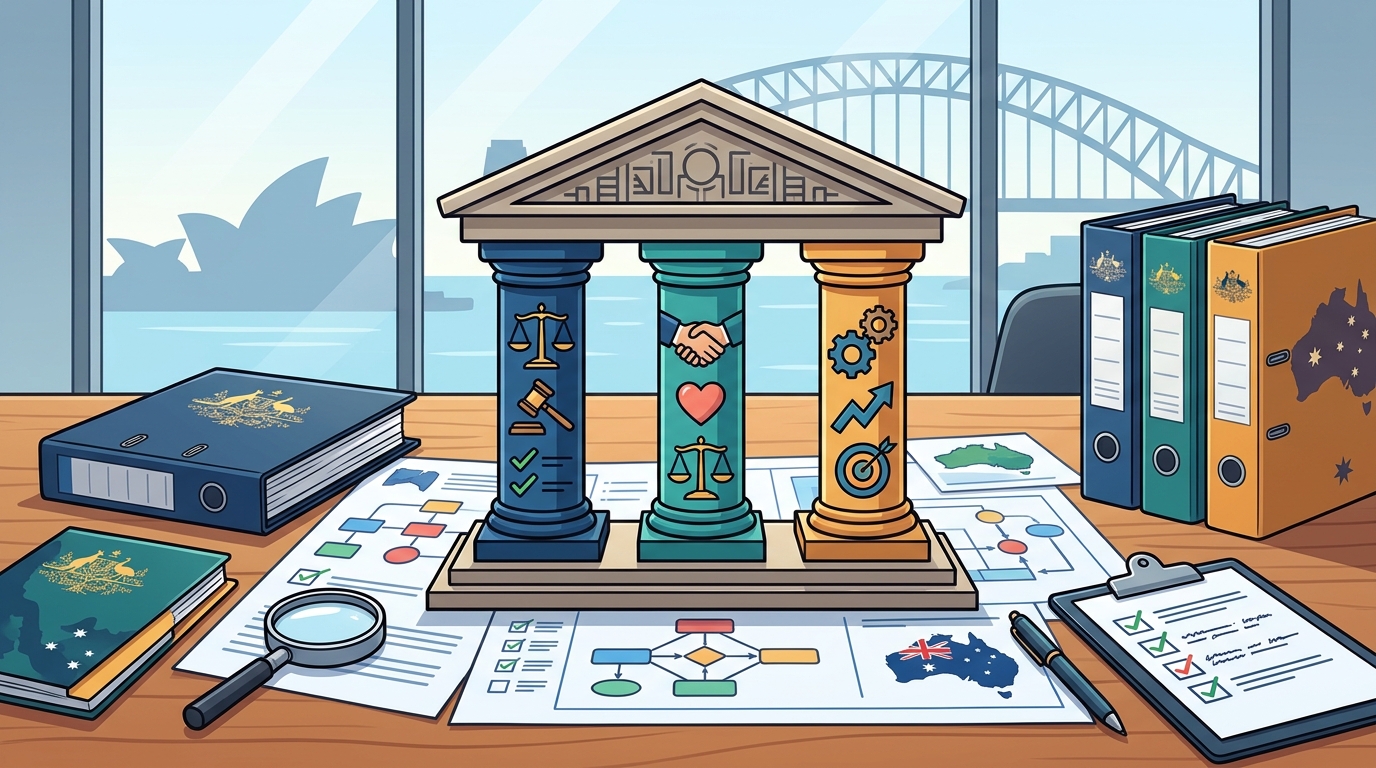
Effective governance rests on three main pillars: compliance, ethics, and strategic alignment. Compliance ensures the business meets the Fair Work Act and other Australian employment laws. Ethics covers the moral standards guiding employee treatment, while strategic alignment links HR actions to corporate goals. Without these pillars, a company risks legal penalties and cultural drift.
Compliance as a Foundation
Compliance is the non-negotiable baseline for any Sydney employer. It involves regular audits of payroll, leave entitlements, and workplace health and safety records. A robust governance model treats compliance not as a box-ticking exercise but as a continuous monitoring process. This proactive approach reduces the risk of industrial disputes and regulatory fines.
Ethical Decision Making
Ethics in HR governance refers to the principles that guide how employees are treated in sensitive situations, such as performance management or redundancy. A clear code of conduct provides a reference point for managers when they face difficult choices. This consistency builds trust and reduces the likelihood of wrongful dismissal claims.
Building a Transparent Policy Framework
A transparent policy framework is a set of documented rules that are accessible to all employees and clearly defined in scope. In a growing business, policies often become outdated or fragmented. Good governance requires a central repository where all HR policies are version-controlled and easily accessible. This transparency ensures that every employee, from the CEO to the newest hire, operates under the same set of rules.
Documenting the Employee Lifecycle
Documentation should cover the entire employee lifecycle, from recruitment to offboarding. Each stage requires specific governance controls. For example, recruitment policies must outline how candidates are assessed to ensure fairness. Offboarding policies must detail how access is revoked and how knowledge is transferred. This end-to-end documentation creates an audit trail that protects the business.
Regular Policy Reviews
Policies are not static documents. They must be reviewed regularly to reflect changes in legislation and business operations. An annual review cycle is a common best practice, but high-growth companies may need more frequent updates. It is advisable to assign clear ownership for each policy to ensure accountability during these reviews.
Role of Leadership and Accountability
Leadership accountability is the mechanism that ensures HR policies are actually followed. It is not enough to have a policy; someone must be responsible for enforcing it. In a well-governed organization, the board or senior leadership team holds the ultimate responsibility for the HR function. This top-down commitment signals to the rest of the organization that HR standards are serious.
Defining Clear Roles
Clear role definitions prevent gaps in oversight. Who approves a new hire? Who investigates a grievance? Who signs off on a performance improvement plan? Ambiguity in these roles leads to delays and inconsistent decision-making. A RACI matrix (Responsible, Accountable, Consulted, Informed) is a useful tool for clarifying these responsibilities across the organization.
Board Oversight
Managing Risk in a Growing Organization
Risk management in HR is the process of identifying, assessing, and mitigating potential threats to the workforce. As a business grows, new risks emerge, such as managing a larger, more diverse team or expanding into new locations. Good governance involves a risk register that tracks these potential issues and outlines mitigation strategies. This proactive stance allows the business to address problems before they escalate.
Identifying Key Risks
Mitigation Strategies
Mitigation strategies vary by risk type. For compliance risks, the strategy might be regular training for managers. For cultural risks, it might be implementing an employee engagement survey. The key is to have a plan in place before a crisis occurs. This preparedness is a hallmark of mature HR governance.
Measuring Governance Effectiveness
Measuring effectiveness is the practice of using data to evaluate whether HR governance is working. Without metrics, it is difficult to know if policies are having the desired impact. Key performance indicators (KPIs) provide a quantitative view of HR health. These metrics should be reviewed regularly to identify trends and areas for improvement.
Key Metrics to Track
Continuous Improvement
Metrics should drive continuous improvement. If a metric shows a negative trend, the organization should investigate the root cause and implement changes. This cycle of measurement and adjustment is what makes governance dynamic rather than static. It ensures that the HR function evolves alongside the business.
Key Takeaways
- Good HR governance combines compliance, ethics, and strategic alignment to protect the business.
- A transparent policy framework ensures all employees operate under consistent, documented rules.
- Leadership accountability is critical; senior leaders must own the HR function and its outcomes.
- Risk management involves proactively identifying and mitigating potential workforce threats.
- Regular measurement using KPIs provides visibility into the effectiveness of HR practices.
Frequently Asked Questions
What is the primary purpose of HR governance?
The primary purpose of HR governance is to ensure that human capital decisions are made in a way that is legally compliant, ethically sound, and aligned with business strategy. It provides a framework for accountability and transparency in all HR-related activities.
How often should HR policies be reviewed?
HR policies should be reviewed at least annually to ensure they remain compliant with current legislation and relevant to the business's operations. High-growth companies may need to review policies more frequently, such as every six months, to keep pace with rapid changes.
Who is responsible for HR governance in a small business?
In a small business, the owner or general manager is typically responsible for HR governance. As the business grows, this responsibility may shift to a dedicated HR manager or director. Regardless of size, clear ownership is essential for effective governance.
What are the consequences of poor HR governance?
Poor HR governance can lead to legal penalties, increased employee turnover, reputational damage, and a toxic workplace culture. It can also result in costly industrial disputes and a lack of strategic alignment between HR and business goals.
How can HRM Consulting help with HR governance?
HRM Consulting helps Sydney businesses by assessing their current HR practices, identifying gaps, and implementing robust governance frameworks. They provide expert guidance on policy development, risk management, and leadership accountability to ensure sustainable growth. Learn more: hrmconsulting com au.